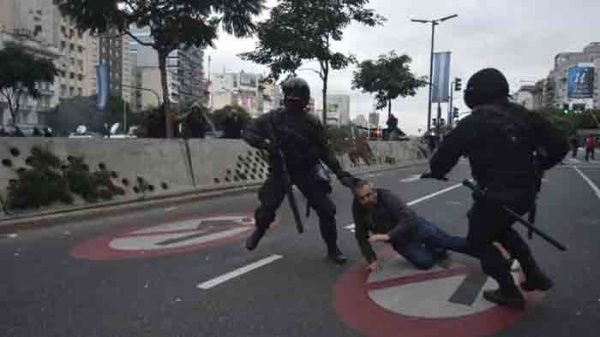

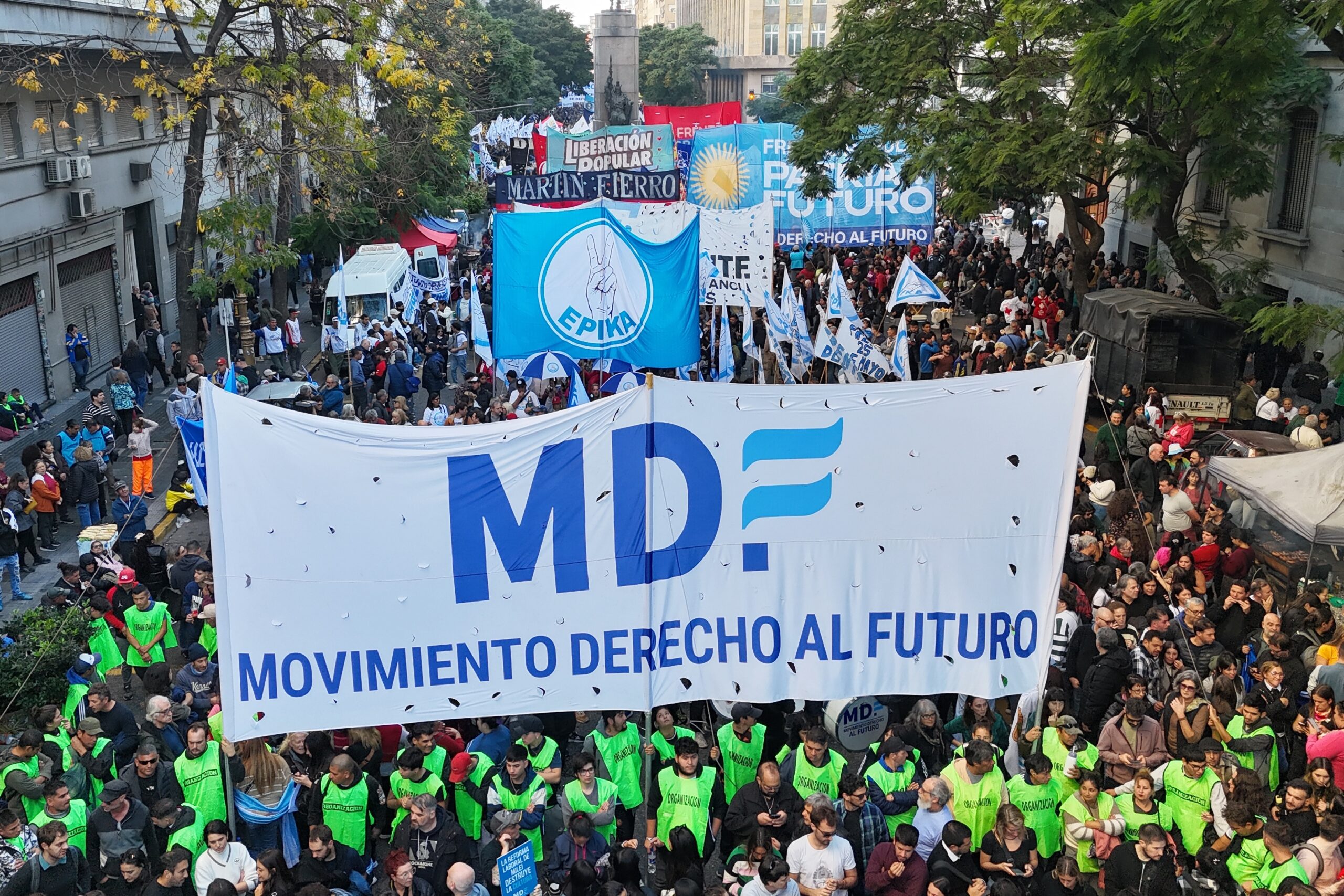
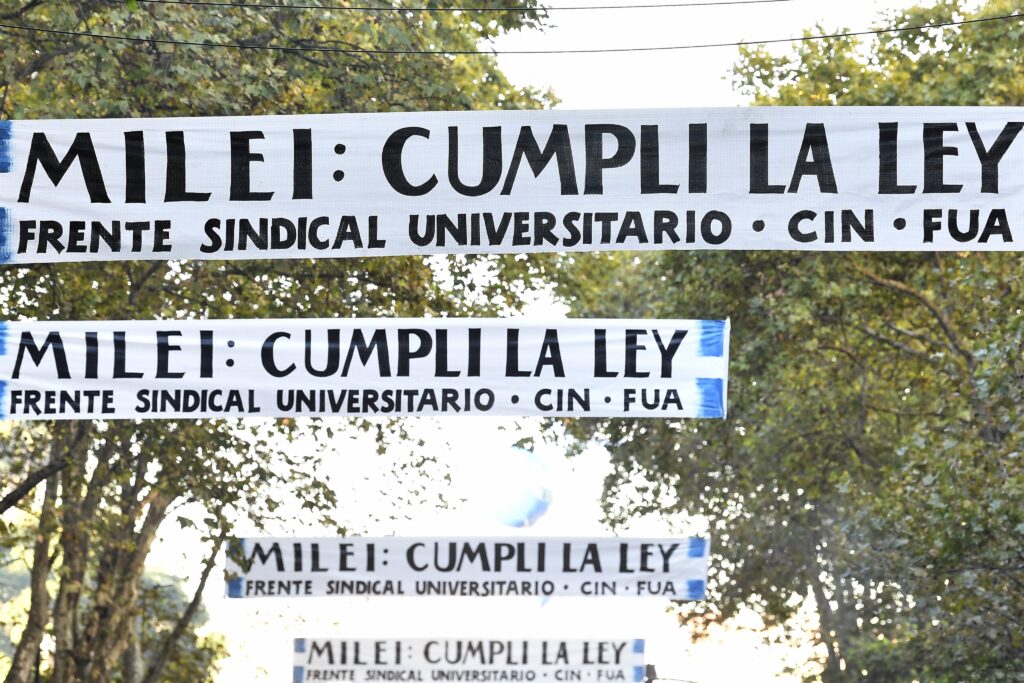
Buenos Aires, Argentina — Thousands of professors, administrative staff, students, and graduates marched across Argentina on Tuesday to demand that the government comply with a university funding law approved last August.
It was the fourth such “Federal University March”, brought about because of persistent budget cuts to higher education and the sciences since Javier Milei became president in 2023. Since then, government budget allocations to national universities fell 45.6%, the National Inter-University Council (CIN) reported.
Under current law, the government has adjusted for inflation professors salaries and operating costs, leading to a surge of resignations and other teachers forced to find additional jobs. Although Congress passed the public university funding bill in August 2025, Milei quickly vetoed it, citing his commitment to a zero-deficit policy.
Read more: Despite large protests, Argentina’s Javier Milei vetoed university spending bill
By September, lawmakers in both chambers rejected the veto, officially enacting the bill into law.
Nevertheless, the president has effectively stalled its implementation via decree, arguing that the law remains on hold until specific funding sources are identified.
In late March, a federal court ordered the government to comply with a segment of the norm that granted a salary raise for university staff, which was considered the most urgent item in the bill.
In an attempt to dodge its obligations, the government has appealed to the courts and a lower appeals court has just granted the administration’s request to elevate the case to the Supreme Court and suspend the law’s implementation in the meantime. Final word on the matter now lies with the country’s highest tribunal.
Despite Tuesday’s mass mobilization that gathered over 600,000 people in the capital Buenos Aires and nearly 1 million across Argentina, the University of Buenos Aires (UBA) said that the government decided to double down.
“You could have a hundred thousand, a million or five million people on the streets, but the budget restriction will continue,” said Alejandro Álvarez, the Undersecretary of University Policies.
A day before the march, whose slogan called on Milei to “Comply with the law, do not mortgage the future,” the president’s administration cut more projects, including $5.3 billion pesos (US$3.8 million) destined for university building maintenance and $2 billion pesos (US$1.4 million) in science scholarships. Between education, science, technology and direct transfers, the administration has cut over $110 billion pesos (US$79 million).
Before Milei took office, higher education funding accounted for 0.72% of the Gross Domestic Product (GDP) in 2023; it’s currently around 0.47% of GDP.
The impact is stark, and nowadays, some of Argentina’s best public universities are being pushed to the brink, according to their faculties. Universities have complained about deteriorating facilities, rationing electricity, faculty salary cuts and a drop in extracurricular activities, among other things.
Historic lows and the “brain drain” threat
The current higher education budget is at a two-decade low, plunging funding below levels witnessed during the 1989 hyperinflation crisis (0.44% of GDP) and approaching the absolute minimums recorded during Argentina’s military dictatorship, according to a report by the Ibero-American Center for Research in Science, Technology, and Innovation (CiiCTi).
One of the most pressing medium-term challenges is the retention of academic staff. Faculty salaries have plummeted by 32% since Milei’s La Libertad Avanza administration took office, prompting approximately 10,000 resignations, according to CIN data.
The exodus has left vacant teaching positions in areas deemed highly strategic for the government’s own economic model, including sectors like energy, technology, and mining.
At the University of Buenos Aires alone, the Faculty of Exact and Natural Sciences reported the loss of 438 professors and researchers between December 2023 and April 2026.
“We are losing one every two days,” a faculty member who asked not to be named for fear of retribution, told Argentina Reports. The Engineering department saw an additional 342 departures.
A historic setback: Funding drops below 2002 and 1976 levels
The situation is equally critical for science and technology, where analysts warn of a virtual dismantling of the country’s research matrix.
Federal spending on science and technology fell by 39.3% during the first quarter compared to the same period in 2023, projecting a real-term decline of 47.7% by the end of the three-year cycle, the CiiCTi report noted.
This sustained budgetary squeeze will reduce the sector’s funding to just 0.149% of GDP, the lowest level recorded since historical recording began in 1972.
To grasp the magnitude of the fiscal adjustment, the current level of funding pierces the floors seen during the worst phase of the 2002 economic collapse (0.177% of GDP) and the onset of the military dictatorship in 1976 (0.194% of GDP).
These official figures also confirm the government’s failure to meet the targets set by the suspended science funding law, which legally required the state to invest 0.520% of GDP in the sector this year.
An ideological debate over the role of public education
Beyond a 40.3% drop in the purchasing power of salaries and scholarships at Argentina’s National Scientific and Technical Research Council (CONICET) since November 2023, the funds required to keep research projects active are virtually paralyzed.
The Agencia I+D+i, the country’s main innovation and development agency, has suffered a severe 86.3% cut over the last three years.
This is compounded by the financial asphyxiation of cutting-edge institutions: the National Space Activities Commission (CONAE)—key to Argentina’s participation in NASA’s Artemis mission—faces a 61.2% cut, while the National Atomic Energy Commission (CNEA) and the National Agricultural Technology Institute (INTA) have seen their budgets slashed by nearly 47%.
Featured image: Hundreds of thousands of people gathered in Buenos Aires and other parts of Argentina on May 12 to protest budget cuts to the higher education system.
Image credit: Governor of the Buenos Aires Province Axel Kicillof via X.