

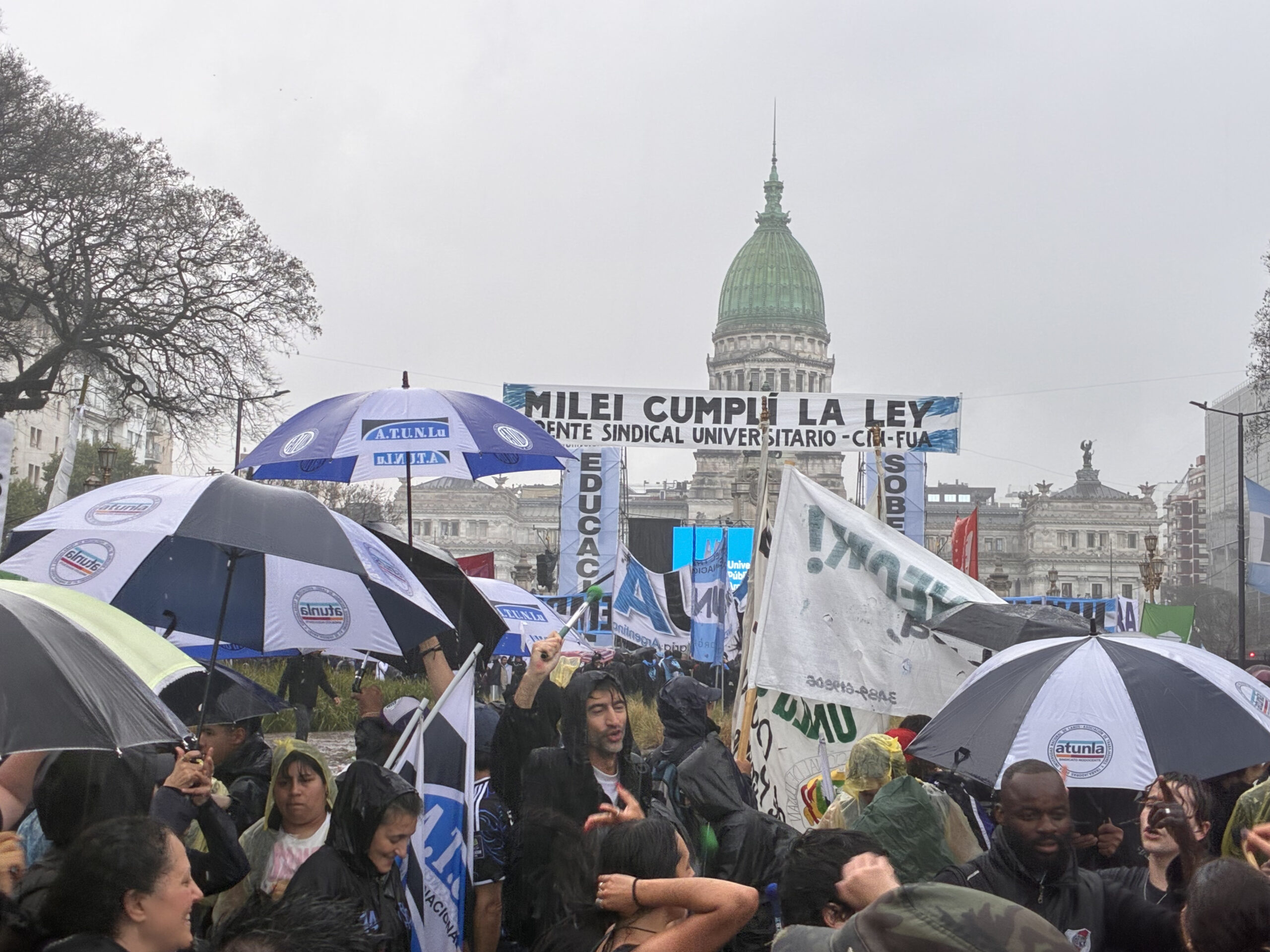
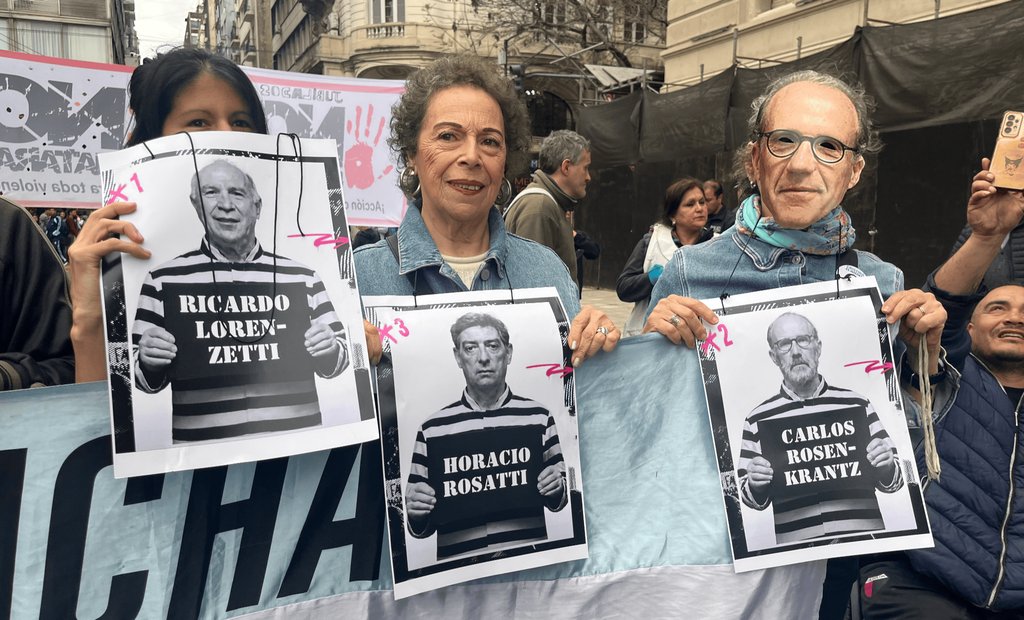
Buenos Aires, Argentina — Thousands of people took to the streets across Argentina on Thursday in another large protest against President Javier Milei’s government, rejecting severe cuts to public university funding that the executive branch has carried out despite a law passed by Congress and a Supreme Court ruling.
It was the fifth Federal University March, a call to action by universities nationwide that brings together professors, students and civil society groups. Organizers estimated turnout at nearly 1 million people across the country. The main rally took place in Buenos Aires, in front of the Plaza del Congreso, where, ironically, the government had just won a political victory inside the building.
University groups had been building toward the march for weeks. They are demanding that the government comply with the University Financing Law, which requires that university budgets be adjusted monthly for inflation. Professors say the lack of adjustments has pushed the system to the breaking point and has driven an exodus of professionals who left their posts because of very low pay.
“The government’s defunding hits first in the pocket. Salaries ‘rise’ below inflation, and the loss of purchasing power among university teachers has reached 40% in two years,” said Martín Farina, a teaching assistant in the evolution area at the University of Buenos Aires (UBA) School of Exact and Natural Sciences, known as Exactas.
Farina, whose job involves organizing practical classes, designing seminars and, when needed, overseeing lab work for undergraduates, told Argentina Reports that he has recently struggled with overcrowded classrooms caused by a shortage of instructors. “It’s hard to fill all the professor positions now,” he said. “And there’s a migration toward private universities and abroad.”
Material shortages have compounded the financial blow. “Infrastructure is starting to suffer,” he said. “At Exactas, the elevators couldn’t be used, or are used less so they don’t wear out. There is complex equipment that can’t be maintained, and that will cause losses down the road.”
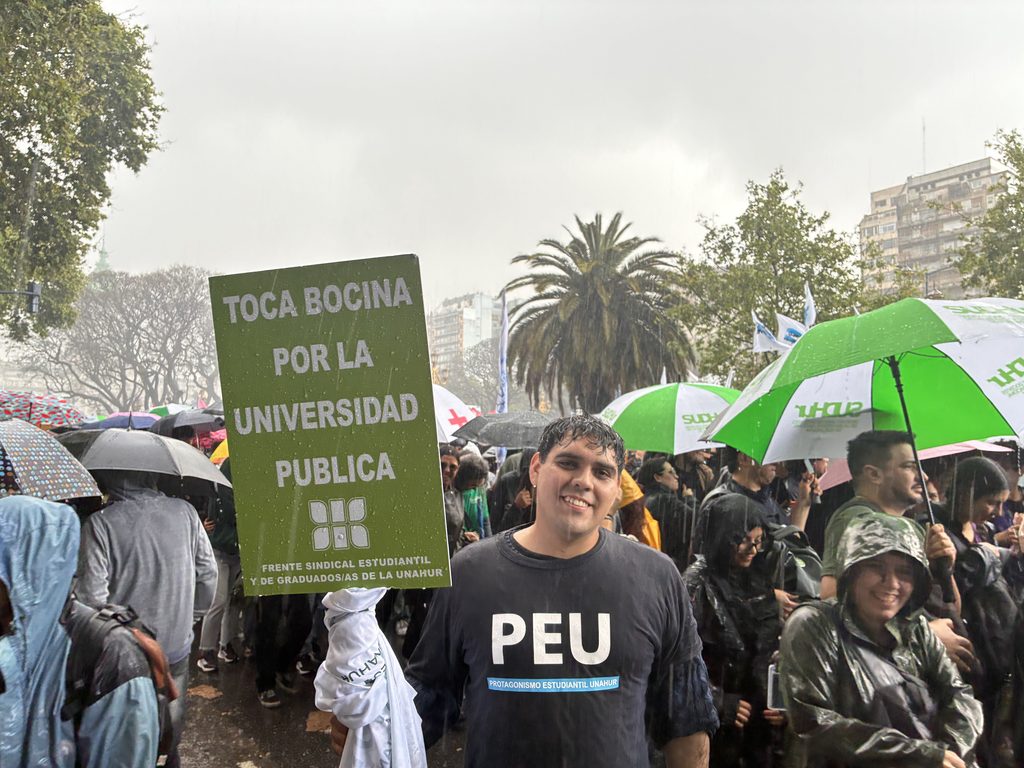
Marching in the rain
Thursday was an intense day at Congress, both inside the chamber and on the streets.
Early on, the opposition tried to muster the quorum needed to hold a session in the Chamber of Deputies, the lower house, to overturn a decree that is key to Milei’s agenda. The measure, Decree of Necessity and Urgency 70/23, was issued by the executive branch in the first weeks of his term in 2023. It became the foundation for the deregulation and market-opening policies that have defined the past two years in Argentina.
The decree includes a provision repealing the Land Law, which limits the sale of land to foreign nationals. That provision has become controversial in public debate in recent weeks.
But Casa Rosada, the office of the president, negotiated with some allies to sink the quorum and save the decree. The opposition fell short by just eight deputies.
Outside, social groups began gathering near Congress by midday. Unlike other, more partisan demonstrations, university marches draw a broader crowd. Most of those present were under 30, but there were also older people and some families, all braving overcast skies that threatened rain throughout the day.
“I march for my children and for myself, for everything the earlier generations won that is now being destroyed,” said Adriana, 59, who came with her son, Agustín, 27. “That’s why I march: for education, for health care, for an equal society.”
The two stood out among the signs and umbrellas: both were dressed as Gandalf, the wizard from “The Lord of the Rings.” The costume has taken on a double meaning in Argentina in recent months, ever since a group of protesters dressed as Gandalf gathered outside the Buenos Aires mansion that billionaire Peter Thiel bought this year. Palantir, the mass surveillance data-analytics company he co-founded, takes its name from a mystic object from J.R.R. Tolkien’s book.

Both are proud UBA students: She studied business administration and he is studying optics. He said he has felt the stagnation caused by underfunding in recent months, but that professors’ dedication keeps the program afloat. “It’s a degree that, if it weren’t public, there aren’t many chances to study,” he said. “And it has great job prospects, which is exactly what’s being so debated right now.”
“Every time we go to class, we have fewer chairs, fewer class times, fewer professors,” said Micaela, 26, a writing student at the National University of the Arts (UNA). She lives in Pablo Podestá, a town about 12 miles outside Buenos Aires, and came with two classmates who also live in the city’s suburbs. They said they are affected not only by education cuts but also by transportation cuts: fewer bus lines and less frequent service to get to class.
“There were very well-known people teaching who had to leave because the salary wasn’t enough for them,” said Victoria, 23.
The march ended on a sour note.
Around 5:00 p.m., as people began to leave, tension flared near Congress when a handful of protesters started throwing stones at police, who responded by spraying pepper spray at the crowd.
Argentina’s Security Ministry said 31 people were detained. Property was also damaged.
Featured image: Argentines gathered on the streets of Buenos Aires on October 15, 2026 to protest university funding cuts.
Image credit: Mariano Vidal for Argentina Reports.