

Buenos Aires, Argentina — An Argentine federal court on Friday, October 23, closed the $LIBRA cryptocurrency case, dismissing a complaint against President Javier Milei and ten other suspects in a ruling that the opposition and the scheme’s alleged victims strongly criticized, claiming it reflected an alleged exchange of favors between the government and the judges assigned to investigate it.
But the last word may yet have been spoken. Amid the backlash against the decision, another prosecutor specializing in government corruption cases asked the judge to allow the investigation to continue, arguing that there was still evidence to be examined.
Judge Marcelo Martínez de Giorgi had ended the investigation 10 days ago at the request of prosecutor Eduardo Taiano, who argued there were no grounds to investigate a crime. With the alleged victims removed as plaintiffs, no one appeared to have standing to appeal.
To make his case, Taiano relied on a report from the Anti-Corruption Office, an agency under the Justice Ministry, which concluded that Milei used his X account in a personal capacity, not as head of state.
“It’s outrageous to use the Anti-Corruption Office’s report to validate something Milei did. The office answers to Milei,” Nicolás Oszust, a lawyer for some of the victims, told Argentina Reports. “You can’t use an agency that depends on the person you’re investigating. It can’t have evidentiary value.”
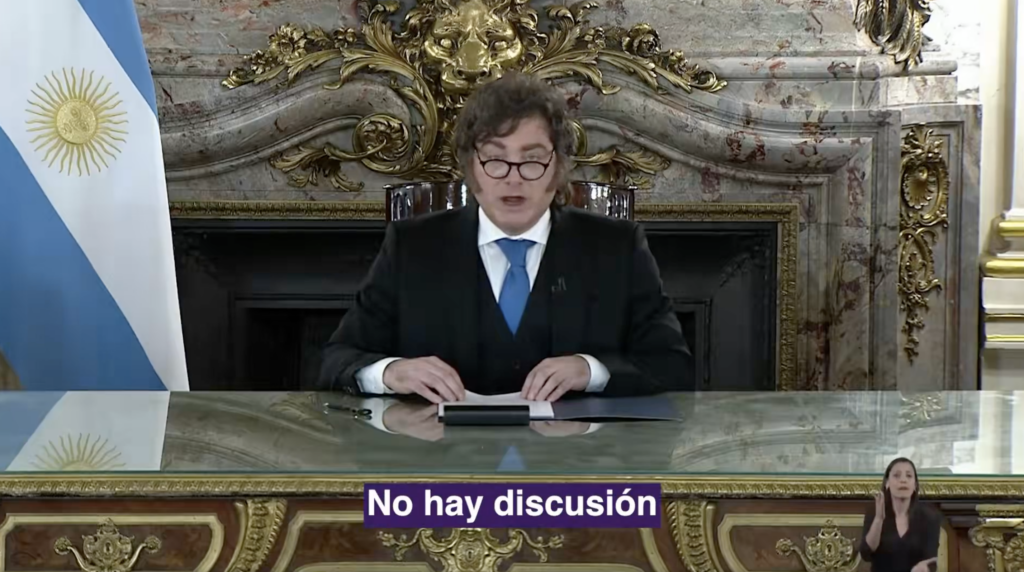
After the ruling, Milei lashed out at the media, spoke of a “press operation” and threatened legal action against journalists he accused of defaming him. During an appearance at a libertarian think tank, he named several reporters who had covered the case and then said: “The sons of bitches should be burned at the stake.”
Before Martínez de Giorgi’s decision to close the case, the alleged victims had appealed their removal as plaintiffs. They argue that until the courts rule on that appeal, they retain the status of pretensos querellantes — prospective plaintiffs — a legal designation that preserves at least a limited possibility of continuing their fight through the courts and preventing the case from being closed.
On Friday, the Administrative Investigations Office (Procuraduría de Investigaciones Administrativas, or PIA), a specialized prosecution office that investigates corruption and administrative irregularities within the Executive Branch, also challenged the dismissal of the eleven suspects before Martínez de Giorgi. It argued that the investigation contained indications of a possible fraudulent scheme and should continue.
The appeal was signed by prosecutor Sergio Rodríguez, who asked to take over the investigation abandoned by Taiano. He listed several outstanding investigative measures, including blockchain analysis — which Taiano’s office had ruled out because it lacked specialized software — and forensic examinations of several cellphones.
“The case investigates whether $LIBRA was created to deceptively induce people to invest, using the president’s promotion, endorsement and publicity as bait, before collecting the money raised and fleeing. The current state of the case is not the end of the investigation, but rather the evidence-gathering stage, with findings that appear to point to a fraudulent agreement,” Rodríguez wrote in the filing, obtained by Argentina Reports.
A scandal born on X
As with many of the scandals Milei has faced, it began with a post on X, formerly Twitter. At 7:00 p.m. on February 14, 2025, the president shared a 44-character smart contract address for a cryptocurrency created hours earlier. He said it would help fund small and medium-sized businesses in Argentina. It was called $LIBRA.
Right after the post, the token’s price jumped from fractions of a cent to nearly $5, then plunged about 40 minutes later, leaving thousands of buyers with losses and prompting accusations of a crypto scam.
In between, the token’s creators pulled nearly $110 million in liquidity from the market, a maneuver known in crypto as a “pump and dump,” in which a popular figure’s endorsement artificially inflates an asset’s price before insiders cash out.
The episode went around the world and became the first major headache for a president who had spent his first year in office largely free of setbacks.
But the origins of the scandal go back months earlier, to a pair of trading-sector lobbyists close to the president, Mauricio Novelli and Manuel Terrones Godoy. In October 2024 they organized the Tech Forum, an event meant to connect crypto investors with government officials.
Charles Hoskinson, a co-founder of Ethereum, alleged that attendees were asked to pay for one-on-one meetings with Milei. He said he refused and described it in a video on X.
Among those at the event was Hayden Davis, a low-profile memecoin entrepreneur who described himself as a Web3 and blockchain specialist. Davis traveled to Argentina several times, with Novelli and Terrones Godoy as guides. They put him in touch with Milei and arranged a January 30, 2025 visit, at which, Clarín reported, Milei and Davis signed a contract naming Davis an adviser.
Hours later, Davis sent $1 million in cryptocurrency to the wallet of an Argentine intermediary. Blockchain tracing by Argentine authorities showed the intermediary had ties to Novelli.
Two weeks later, Novelli, Terrones Godoy and Davis took part in the $LIBRA launch in Dallas, renting a suite at the Ritz-Carlton Las Colinas to set up a studio. Davis had just worked on the launch of the $MELANIA token, which uses the image of the U.S. first lady.
The token was created minutes before launch. It remains unclear who sent the smart contract to Milei. The first winners were 74 crypto wallets that, in what appeared to be insider trading, bought nearly $13 million worth of the token before Milei’s post. One of them took home nearly $8 million in profit within minutes. The identities of those buyers have never been established.
When the price began to fall, things heated up in Dallas and Buenos Aires. Novelli began calling Milei and his top aide, Santiago Caputo, to discuss a venture that social media was already calling a “scam.” Milei deleted his post at midnight, saying he had not known the details of the project and so withdrew his support. The next day Davis said he had pulled the liquidity and held $110 million that belonged to Argentina.
A slow-moving prosecutor
In Buenos Aires, the case exploded. A series of complaints landed with Taiano at the Comodoro Py federal courthouse. Eleven people were named, among them Milei, Novelli, Terrones Godoy, Davis and Karina Milei, the president’s sister and secretary general of the presidency, whom complainants accused of collecting alleged payments for meetings with the president.
Congress set up an investigative commission, led by opposition lawmakers, which heard from more than a dozen witnesses and experts. The Executive Branch systematically refused to recognize its authority, and neither Milei nor a dozen officials the panel sought to question appeared.
Milei has maintained from the start that he used his X account in a personal capacity. His critics say it is absurd to think he can separate himself from his office, and note that his profile carries a gray check mark identifying public officials.
“Milei posting from his X account doesn’t erase his status as president or the influence of his office, or the possible influence peddling,” Maximiliano Ferraro, a Civic Coalition lawmaker who chaired the commission, told Argentina Reports. “It’s a legal absurdity.”
Among the evidence gathered was a forensic examination of Novelli’s phone, which showed dozens of calls between him and the Mileis on the day of the launch. The most striking find was a draft note mentioning a purported agreement with someone identified as “H.” that would lead to $5 million in payments, tied to an announcement of Davis and his firm, Kelsier Ventures, as the president’s crypto and blockchain advisers. Milei did announce Davis as his crypto adviser on January 30, 2025.
Much of the evidence in the file came from investors who bought $LIBRA and joined the case as plaintiffs. In about a year of investigation, Taiano never called any of the people involved for questioning, despite repeated requests from lawyers, who twice sought his removal, saying he was stalling the case.
A turn in the courts
Things began to change this year. In June, Novelli asked that the investors be removed as plaintiffs, arguing they had not shown they were victims. Martínez de Giorgi granted the request.
Two weeks later, the government named the judge’s wife, Ana María Juan, to a vacant federal judgeship.
The investors appealed but ran into a wall at Chamber I of the Federal Appeals Court, where Judge Pablo Bertuzzi rejected their request. Bertuzzi had taken office a day earlier, after being nominated by the government.
“It’s striking how certain facts end up generating at least some suspicion. I don’t want to think the worst, but they force me to,” Oszust said.
Despite the setback, the investors filed another appeal, this time before a higher appeals court. Last week, it seems to be a long shot. Now, things might be different as one of the cases that has caused the government the greatest discomfort may have its last chance of survival.
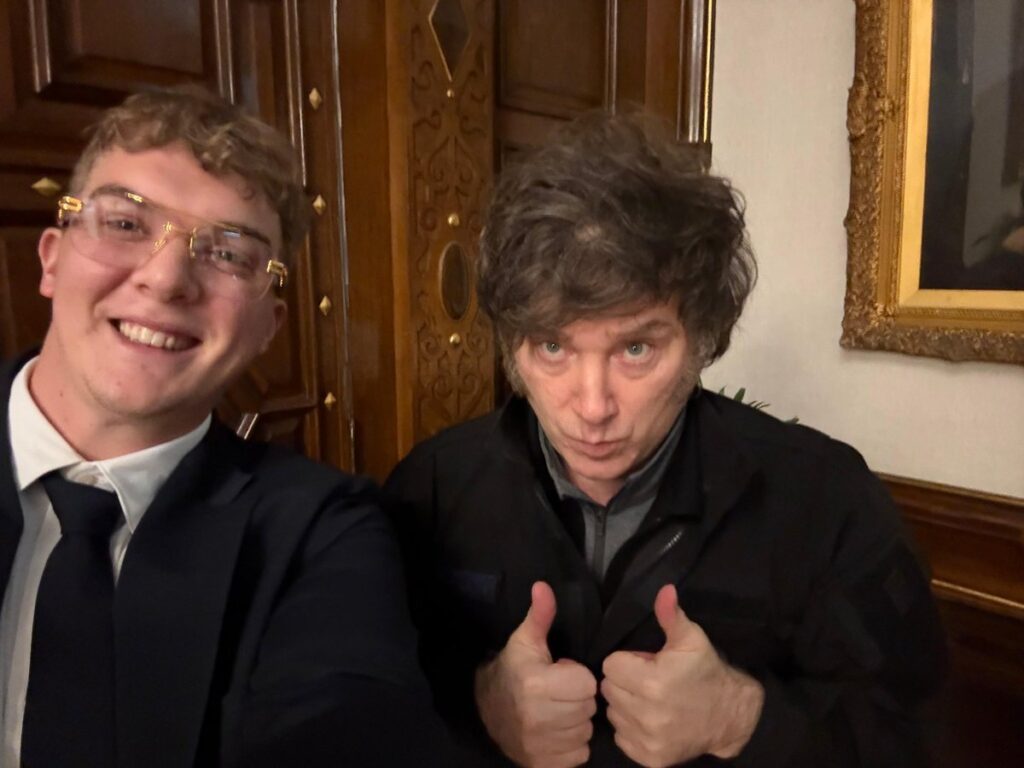
Featured image: Hayden Davis with Javier Milei in Casa Rosada.
Image credit: Javier Milei on X.